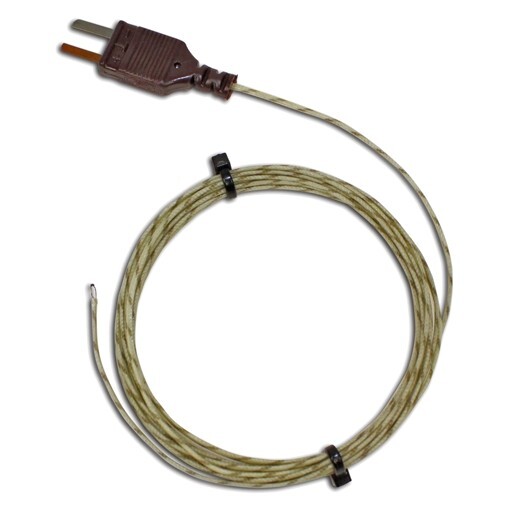
Home PICO | Data Loggers Thermocouple type T, exposed tip, fiberglass insulated, 10 m
PICO | Data Loggers

Thermocouple type T, exposed tip, fiberglass insulated, 10 m

The Thermocouple Type T (FG, 10 m) is a high-precision temperature sensor designed for laboratory, industrial, and educational applications. With 10 meters of flexible fiberglass-insulated cable, it offers maximum reach while maintaining accurate and consistent temperature measurements..

  • Detail
  • Special Features
  • Specification

The Thermocouple Type T (FG, 10 m) uses copper-constantan elements, characteristic of Type T thermocouples, to deliver stable and reliable temperature measurements. The fiberglass insulation protects the cable while remaining flexible, making it suitable for long-distance installations or complex setups.

Its 10-meter length allows convenient sensor placement far from instruments, which is particularly useful in large laboratories, industrial monitoring, or educational setups. This thermocouple maintains signal integrity and provides accurate readings when connected to Type T-compatible devices, ensuring dependable performance in critical applications.

  • Extended 10 m Cable: Ideal for installations where the sensor must be placed far from the measuring instrument.

  • Fiberglass Insulation: Provides excellent heat resistance, durability, and flexibility.

  • Accurate Measurements: Type T thermocouple elements ensure precise readings across a wide temperature range.

  • Durable Design: Can withstand frequent handling and standard operational conditions.

  • Universal Compatibility: Works with all Type T thermocouple instruments and data acquisition systems.

  • Type: T (Copper-Constantan)

  • Insulation: Fiberglass (FG)

  • Cable Length: 10 meters

  • Temperature Range: –200°C to +350°C (application-dependent)

  • Connector: Standard Type T thermocouple connector

  • Accuracy: Standard Type T tolerances per IEC 60584

  • Applications: Laboratory testing, industrial process monitoring, data logging, educational experiments